

Fikri Jermadi dissects the force of nature that is Tan Chui Mui’s latest film.
There are different ways of describing what ‘Barbarian Invasion’ is as a film. On screen, we follow the story of Moon Lee (Tan Chui Mui), a critically-acclaimed actress who is down on her luck, having taken a few years out for personal reasons. She is offered a way back on to the silver screen by Roger Woo (Pete Teo), a filmmaker who has directed her in some of her best-known roles.
However, this film’s role is a break from the mold, as he wants Moon to reinvent herself as a female action star. This is on top of her life role as a single mother to Yu Zhou (Nik Hadiff Dani), after the breakup with Moon’s ex-husband and fellow actor Juillard (Bront Palarae). Though reluctant, she eventually agrees to Roger’s offer and is trained by martial arts expert Master Loh (James Lee).
Another way to look at the film is as a tour de force of Malaysian independent cinema. Behind the camera and on screen, there is a litany of key figures from the Malaysian New Wave scene over two decades ago. The aforementioned James Lee is one such figure; interestingly, his Master Loh could be read as an extension of Lee’s second life as a martial arts practitioner.
A stalwart of his films is Pete Teo, whose tortured soul persona in Lee’s films got him all the way to Hollywood with ‘Ghost in a Shell’. Here, he prowls the screen with a silent menace, flitting between the disgust he feels for others for failing to meet his standards and the depth of his compassion as someone who cares deeply for Moon (more on this later).

Moon’s sparring partner, Awlynn, is played by Aaron Chung, who also first rose to prominence at the same time as the New Wave filmmakers. Though he is not often identified as a part of that collective, his films ‘Crook’, ‘Wicked’ and ‘Hijack’ remain hallmarks of Malaysian independent cinema at the time, amusing audiences at home and abroad.
Chung himself graduated from Akademi Filem Malaysia, a now-defunct film school which Bront Palarae also studied at. If anything, it’s probably easier to list the filmmakers not involved, like Ho Yuhang. Even so, ‘Barbarian Invasion’ (about an actress preparing to make a comeback as an action star) reminded me of his ‘Mrs. K’, which starred Kara Wai making something of a comeback as an action star.
Having said that, both films are interesting explorations of motherhood. Kara’s eponymous character is forced to fight for her family when enemies from the past come for her daughter. Here, Moon has to do the same for Yu Zhou, balancing the demands of single motherhood and her professional aspirations with the spectre of her failed marriage to a high profile personality.
Interestingly, this is not her first rodeo as a single mother on the silver screen, as she did the same thing for Jacky Yeap’s ‘Sometime, Sometime’. Off screen, that role was transfigured from a mentorship role she played for Jacky and his cohorts for the Next New Wave workshop, a space created some years ago for the nurturing of young filmmakers (some of whom features here in minor roles as well).

While it is tempting to remain in this rabbit whole, further exploring the mother figure of Chui Mui on and off-screen, there is another turning point I wish to discuss. Around the time I watched ‘Barbarian Invasion’, I was also concurrently watching the American series ‘Shogun’. I believe a key line from the series (and the novel) is apt for consideration here, as to how a man has three hearts: one for the world, for his friends and for himself.
This film works like that. Without giving too much away, there are also three layers we can peel back for further analysis here. The first is Moon’s public-facing face, where she is essentially performing a role (as discussed above). The second is made more evident to those close to her, as can be seen in her moments with Roger, carrying with them an air of after work confessionals.
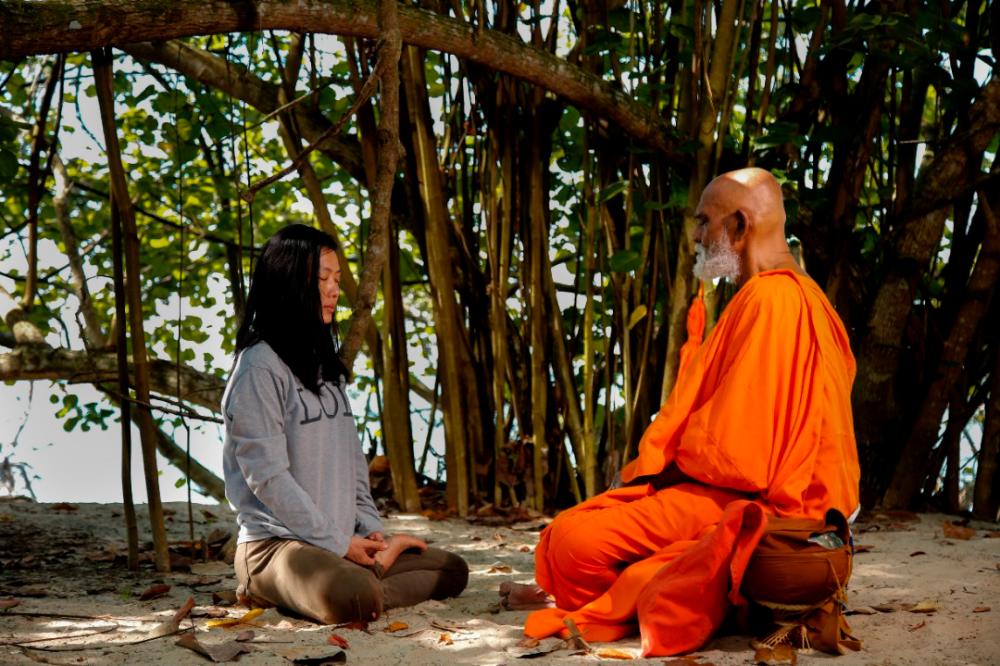
The most intriguing, however, is her inner journey. Along the way, Moon meets a monk (Mano Maniam), who offers morsels of wisdom on her journey of spiritual enlightenment. Maniam played a similar role in Quek Shio Chuan’s ‘Sid and Barry’ from many moons ago (pun not intended). This deeper level, unbeknownst to anyone else, is where Moon really puts the pieces of puzzle together, allowing her to align the other pieces to level up.
There are some discontents worth pointing out. Moon’s relationship with Yu Zhou, for instance, feels a little awkward at times, lacking the kind of intimacy and comfort one may expect from such a relationship. Additionally, some of the twists and turns of the plot can feel a little more contrived, almost as if they’re there for the sake of being there.
Perhaps a slight realignment of the lens is needed to balance things out. As tempting as it is to view Moon Lee as the direct avatar for Chui Mui herself, I feel the key character in this discussion is Teo’s Roger. He ostensibly plays a more supporting role here, cajoling and catalysing others into position. However, that role grows in prominence as the film progresses, as all this is done for the realisation of his own vision.
That, I feel, is the bigger question that Chui Mui is keen to get at, questioning, as time goes by, what it means to be the captain of one’s fate in the bigger picture of life. A significant shot late in the film hints at this, suggesting how Moon’s spiritual journey has perhaps been mirrored (off screen) by Roger’s own, eventually aligning both to achieve a unity of art and life. With that, both Roger and Moon pays off as the two sides of the same coin that is Tan Chui Mui.
Featured image credit: Pavel Danilyuk / Pexels
 thoughtsonfilms.com