
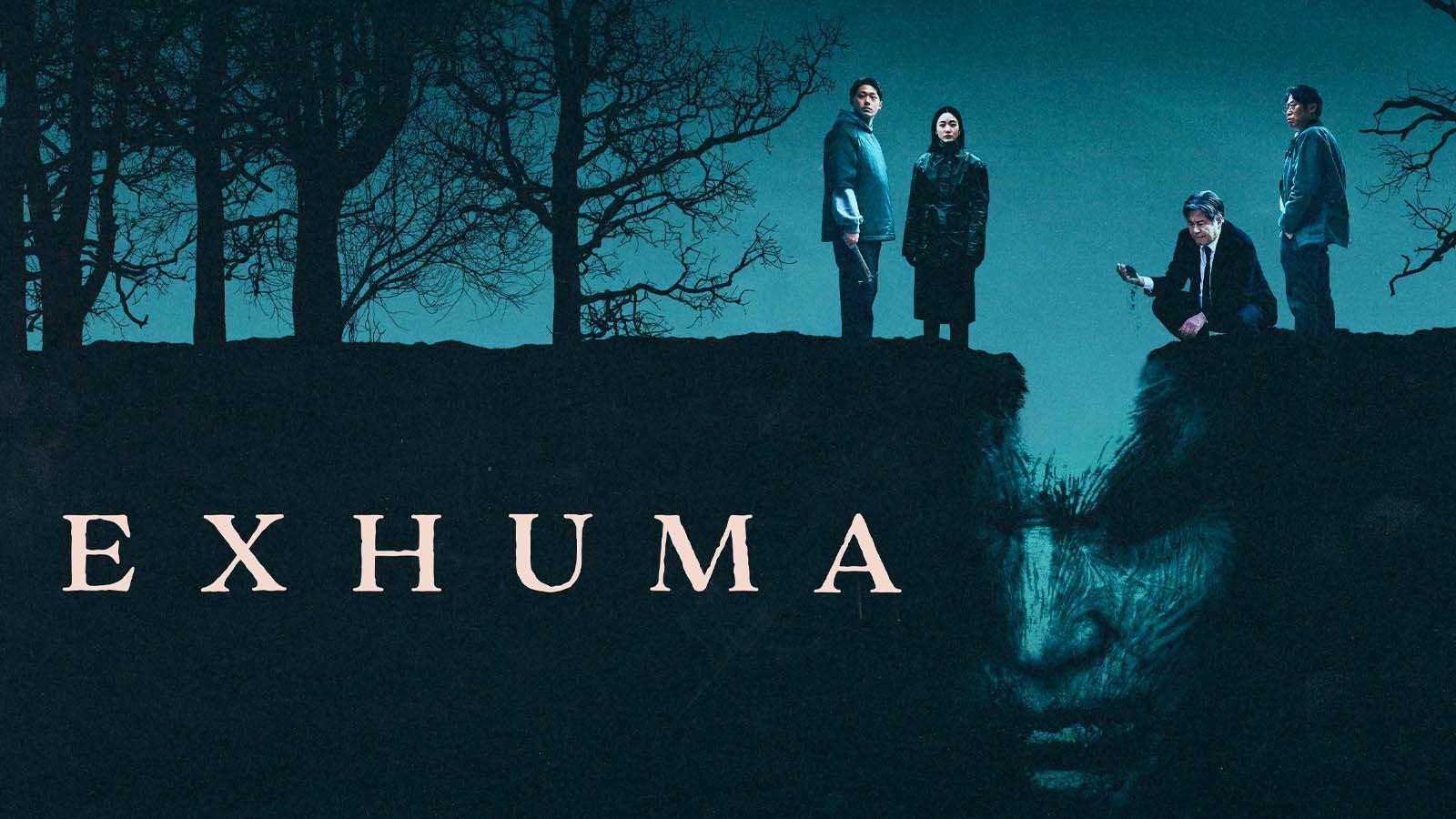
Fikri Jermadi excavates the ways in which Jang Jae-hyun’s film excites him.
In the beginning, one of our protagonists, Lee Hwa-rim (Kim Go-eun), is mistaken by a flight attendant to be Japanese. Though civil, her terse response (in Japanese, it should be noted) made clear her displeasure at such an error. With hindsight, this minor detail sets the tone for the rest of the film, planting narrative seeds in the soil.
The destination of that flight is Los Angeles, as Hwa-rim, a renowned shaman, and her protégé, Bong-gil (Lee Do-hyun), are invited to discover what ails the health of a newborn from an esteemed Korean-American family; with local doctors and medicine unable to figure out what’s what, they turn back to the feng shui of their cultural foundation.
The problem is quickly identified as the Grave’s Call, which is when an evil ancestral spirit haunts their descendants. Realising the gravity of the situation, they engage the geomancer, Kim Sang-deok (Choi Min-sik) and his mortician friend, Yeong-geun (Yoo Hae-jin), for their assistance.
‘Exhuma’ works a range of landscapes, characters and themes. The director, Jang Jae-hyun, flits back and forth between the United States of America and South Korea, with some key scenes even cutting directly between these imaginaries as part of the same sequence. This reflects an interesting engagement with transnationalism between America, Korea and Japan.
For instance, the baby at risk is the scion of fabulously wealthy global citizens, whose comfort in international settings remain the desire of many Koreans. Having said that, many of these elites credit homegrown feng shui elements as the source of their success, meaning that when Western medicine fails to do the trick, another solution could be found closer to home.
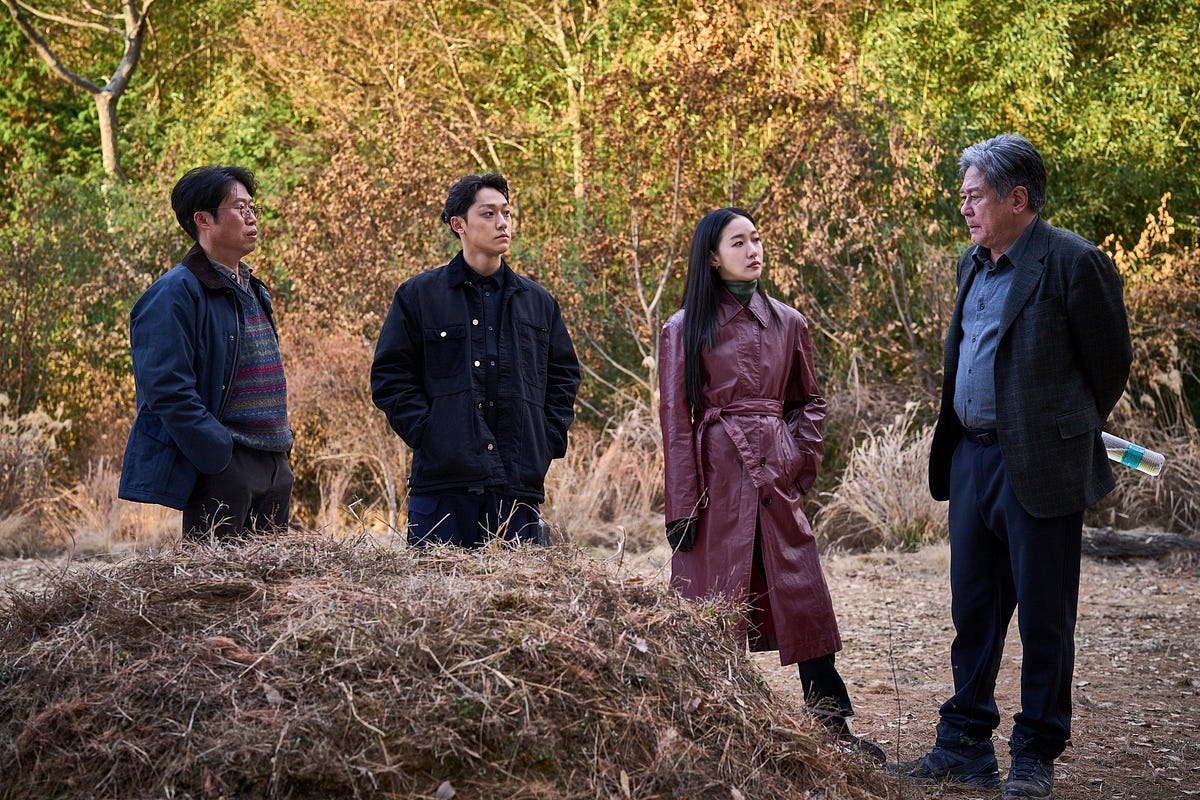
The answer Hwa-rim and Bong-gil found is the relocation of said ancestor’s grave, an endeavour which would become the story’s central MacGuffin. The initial mystery surrounding the initial burial years ago would lead to bigger picture discussions of colonialism and national trauma (more on this later).
What I want to highlight for now is the precision through which Jang Jae-hyun tells the story. His knowledge of such matters should not be a surprise, with his previous films ‘The Priests’ and ‘Svaha: The Sixth Finger’ also couched in similar spiritual explorations within horror. The attention to detail here fills me with confidence of their authenticity, even if I know little of these contexts myself.
For instance, in deciding to move the grave in a certain way, Hwa-rim and her team would need to perform their rituals in a specific way. This is not my first time encountering this on screen, with Na Hong-jin’s ‘The Wailing’ also containing identical elements in its narrative.
What makes this depiction unique is the engaging mise-en-scene. Featuring the sacrifice of animals, with Hwa-rim dancing with nearly reckless abandon, the scene is vivid both visually and aurally, a cacophony that nearly overwhelms your senses. This is due to the quick cuts and dynamic camera, to the credit of both Jung Byung-jin and Lee Mo-gae (the film’s editor and cinematographer respectively).
Anchoring all this (and moving us into the discussion of character) is Kim Go-eun’s Hwa-rim, whose range is a sight for sore eyes. Even in quieter moments, there is a cool charisma permeating from her direction, keeping our eyes on her even when others speak. This is not lost even through her increased vulnerability later in the film.
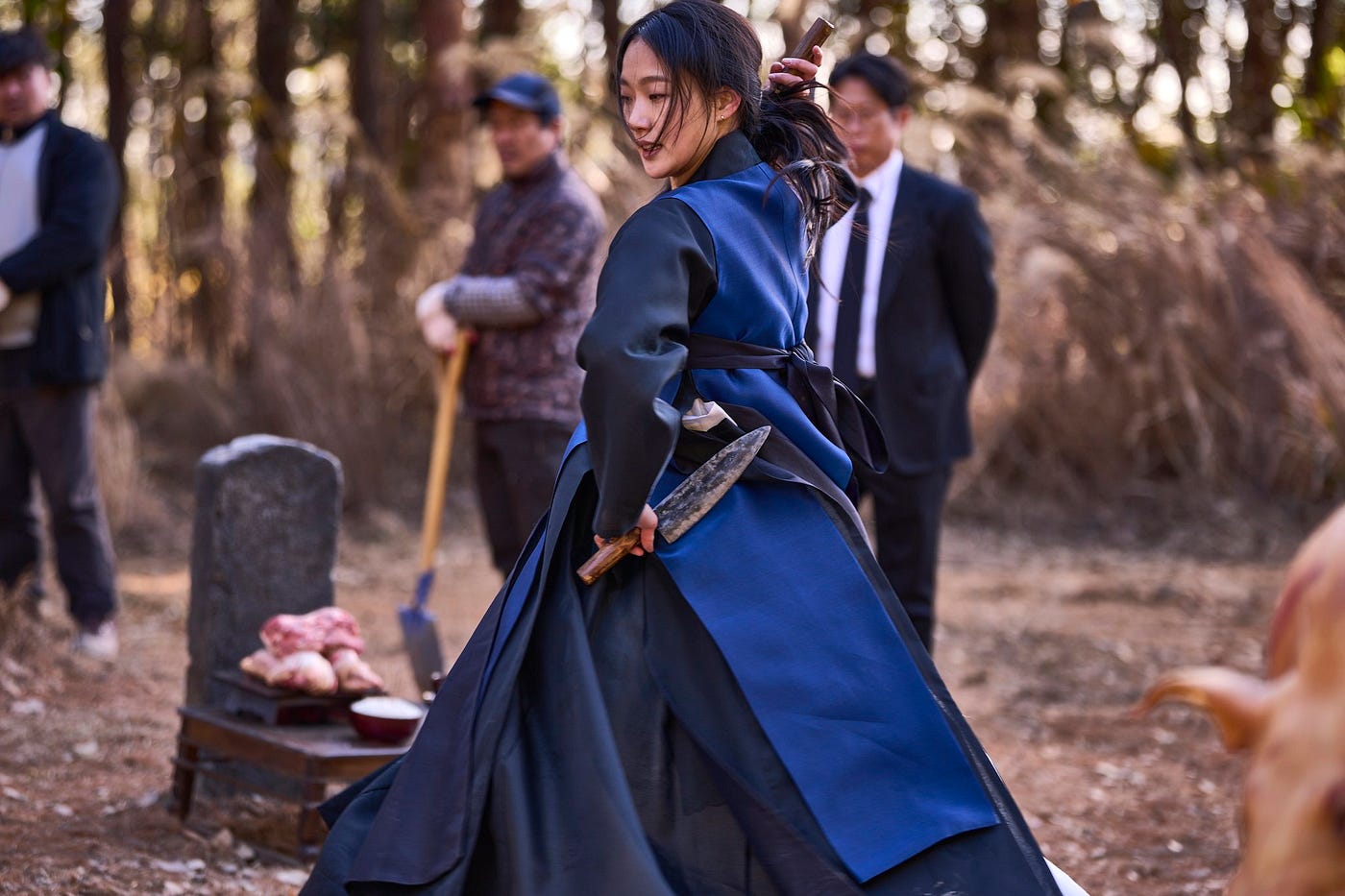
Go-eun does this by balancing the bubbling of emotions beneath the surface with her calm veneer. The aforementioned ritual scene is another example of this, with her physical mannerism and vocal expression a form of controlled chaos; ‘Exhuma’s poster may position Choi Min-sik’s Sang-deok as the main character, but Hwa-rim runs him close as the film’s most captivating.
Of course, Choi Min-sik’s poster placement is well deserved; he is the highest profile actor here, whose gravitas makes Sang-deok central to the film’s narrative. His foil is Yoo Hae-jin’s Yeong-geun, whose reactions (ranging from the comic relief of exasperated sighs to surprised horror) adds the comma, period and exclamation mark to Sang-deok’s doom and gloom.
Speaking of complements, Lee Do-hyun’s Bong-gil is another cool cat on the same wavelength as Hwa-rim. He also carries out some of the physical demands in later scenes with some aplomb. Even someone like the young actress Kim Ji-an injects her character with an effective insouciance in the brief moments she’s on.
This extended deliberation on the actors and their performances is intentional. Horror is a genre where storytellers (on and off the screen) find it easier to push boundaries and get away with it. The trick to great horror, then, is to find that balance between tacit sky-high spirituality and more grounded emotions. In ‘Exhuma’, all the actors contribute to a unified whole.
Much of this is down to the precision of the director’s guidance. While there is room for dramatic license, where possible strong adherence to reality is also prioritised, with real life shamans employed as consultants to ensure this. This means that even what appears to be minor transgressions are emphasised as something important (see the beheading of a small snake).
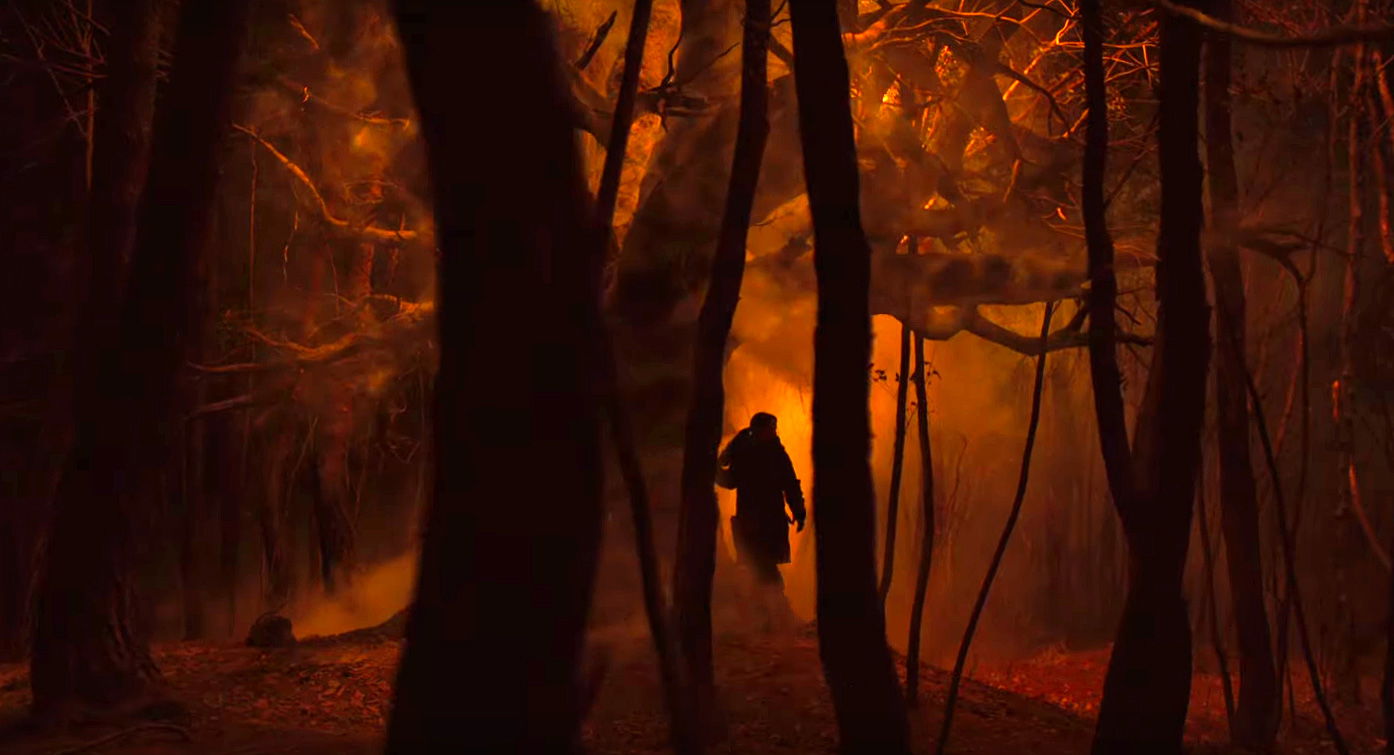
On that note, this is where we pivot to the context of colonialism. Without giving too much away, there is a point in the narrative where Japanese shamans come into the equation, with one in particular (Murayama Junji, played by Jang Ui-don) serving as the film’s Big Bad. Again, this echoes ‘The Wailing’, whose film also moves along very similar tracks.
The four decades of Japanese rule before the end of the Second World War subjugated Korea to spiritual, cultural and ideological traumas. This is shown through the film’s key line of “The fox cuts off the tiger’s waist”, seen as the invaders’ attempt at annexing the Korean peninsula and spirit. In ‘Exhuma’, this is exemplified through the metal spikes implanted by the Japanese throughout the country.
In real life, though the contemporary discourse between the two nations is largely civil, it does not mask a legacy of pain. For instance, the recent passing of Gil Won-ok (one of the last Japanese ‘comfort women’, a form of forced prostitution) renewed calls for justice, a demand which remains unheeded by the Japanese government.
A few days after that, Japan celebrated Takeshima Day, seen as a projection of their sovereignty over islets South Korea calls Dokdo. As such, while the occupation ended long ago, these flare-ups remind us of how sensitive things remain. Therefore, the digging up of the ancestral grave is an allegory of excavating Korea’s own history, with the film’s battles essentially an attempt at spiritual decolonisation.
This comes through in the film’s own narration. At various points, the characters engage in an authoritative voiceover, providing context otherwise unseen. With our discussion in mind, it’s not difficult to see this projection as an expression of pride personal, professional and national, especially with someone like Choi Min-sik leading the way.
Overall, the film’s careful precision unearths a narrative whose stakes and twists are progressively heightened at reasonable intervals, greatly helped by good actors doing great work. ‘Exhuma’ is an exhilarating experience, with Jang Jae-hyun keeping us teetering on the edge without falling over, proving how the devil (or Japanese shaman) is truly in the details.
‘Exhuma’ is nominated in 11 categories at the 2025 Asian Film Awards, including the award for Best Picture.
Featured image credit: Pixabay
 thoughtsonfilms.com