
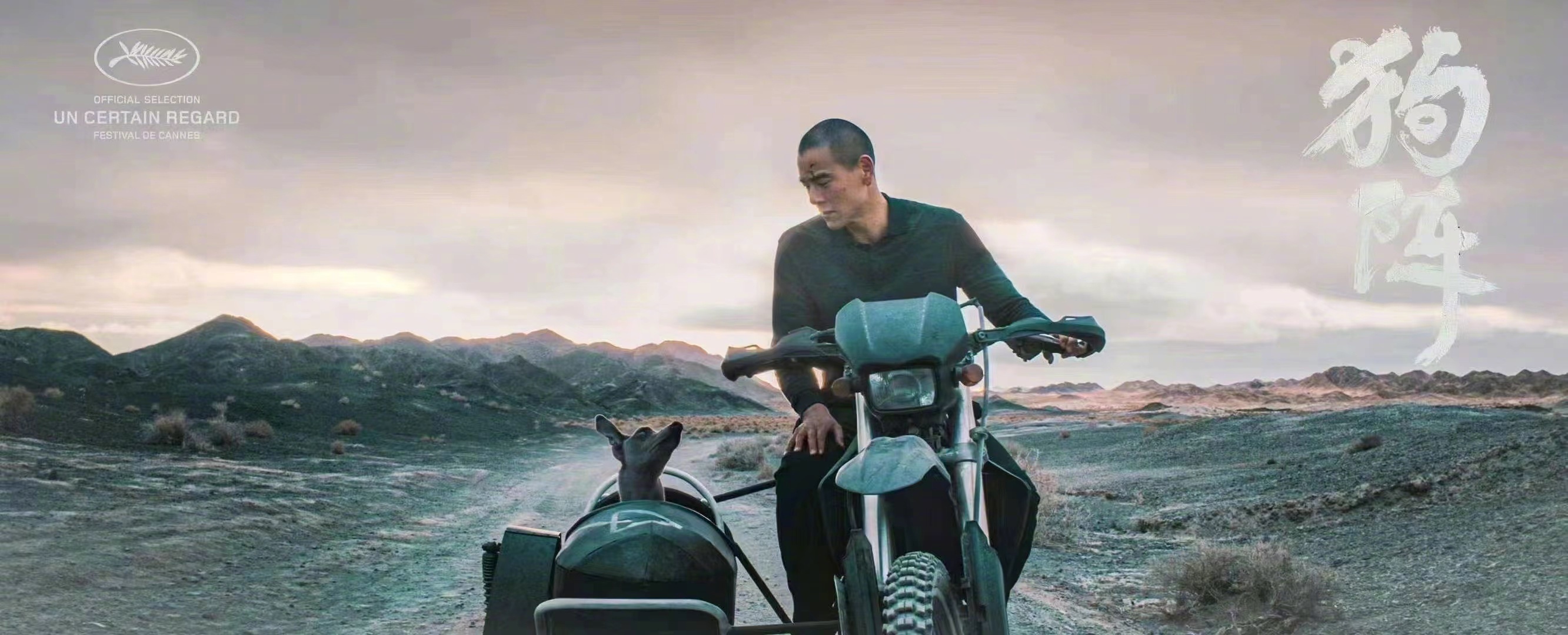
Fikri Jermadi scratches that itch with Guan Hu’s latest film.
‘Black Dog’ is a marked departure from Guan Hu’s recent films. He was one of three directors leading ‘Sacrifice’, which valourised the Chinese army during the Korean War. Similarly, ‘The Eight Hundred’ told their perspective during the Second Sino-Japanese war, while anthology film ‘My People, My Country’ does exactly what it says on the film tin.
It is therefore a pleasant surprise to see this film as an alternative, featuring those far beyond the national locus. Additionally, it could also be seen as a return to his roots, with his initial films (like ‘Dirt’) focusing on more subcultural identities. While the layers in ‘Black Dog’ could be viewed with a critical lens, I believe they are nuances humanising the unseen.
We follow Lang (Eddie Peng), who returns to his hometown, Chixia, on parole from prison. It is near the Gobi Desert, a transitional space bordering China and Mongolia. A former musician, Lang was and still is well known back home, a sheen of celebrity which insulates him from some bad elements.
One of these is Butcher Hu (Xiaoguang Hu), whose nephew’s death is what Lang was sent to prison for. His desire for retribution means that even though Lang is a free man of sorts (his parole conditions do not allow him to leave town), his criminal past makes for a bleak future, which is the name of the game in town.
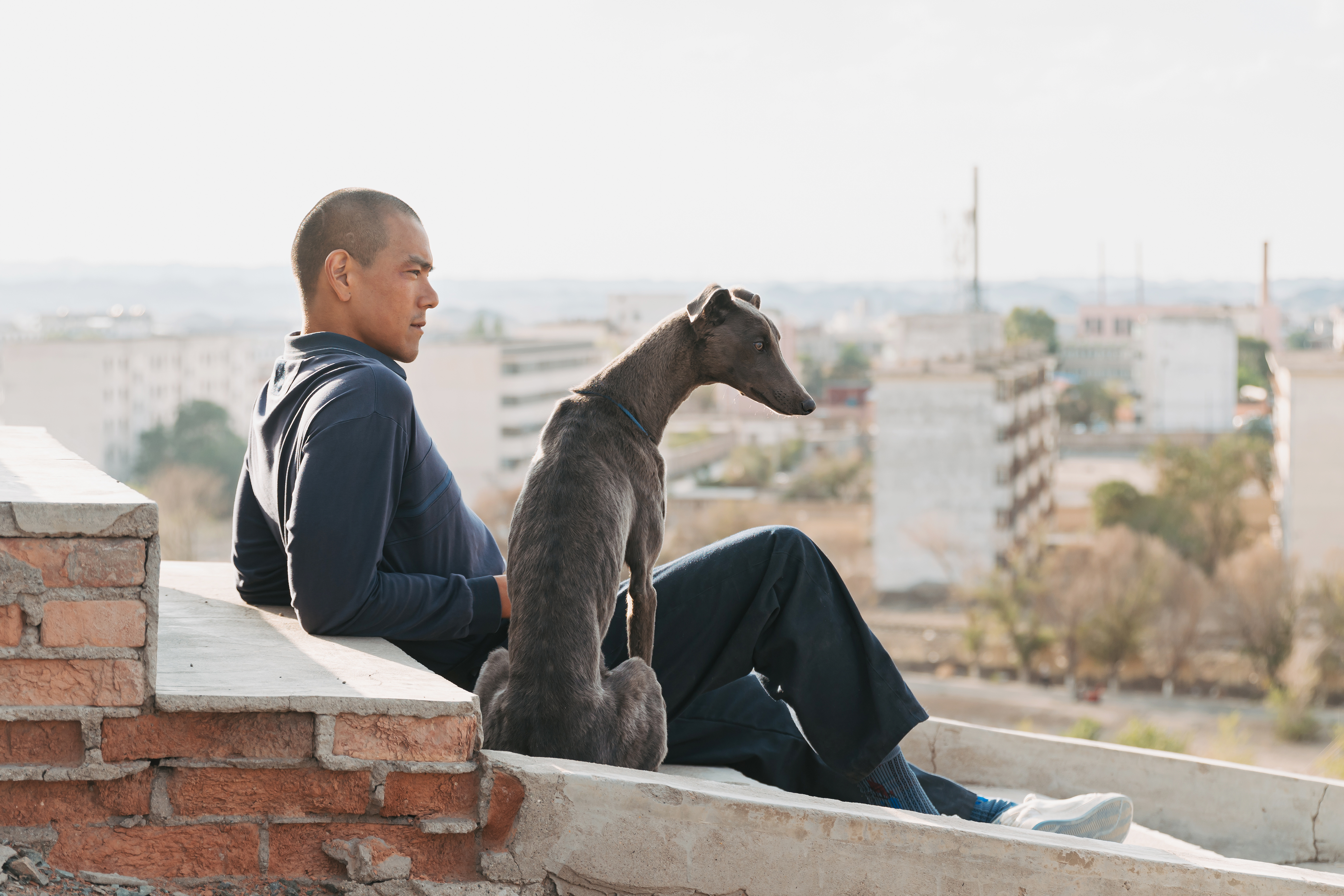
With much of the national development focusing on China’s socio-political centres, ‘Black Dog’ highlights how those on the periphery are shut out from the national discussion. I am reminded of Xiaogang; having been the starting point of capitalism in the country, it is now also clouded by the same sense of desolation we see in this film.
Such situations are made worse by migration patterns pushing away the younger generation who may help to regenerate a place, skewering the demographic with the elderly manning the fort back home. This can be seen by noticing the unseen, with not much by way of children roaming about town.
Making this particularly galling is the year we’re in. Early in the film, Lang walks past a faded wall graffiti of the 2008 Olympics logo. This street art is one way nations build the hype; walk around town, and you’ll see something similar in Jakarta for the 2018 Asian Games. They tend to remain long after the event as well, adding another nuance to the city’s landscape.
That logo made me think that the Olympics had taken place years ago. Imagine my shock, then, to find out that we are still in 2008, some months away from its start. As China bets on the Beijing-based Games to cement its status as a 21st century superpower, that political will and enthusiasm have clearly not bubbled far out enough, making towns like Chixia more of an afterthought than anything else.
Another hint of this is the Olympics promotional truck making its way throughout the town. Its loudspeakers blare out the stock standard phrases promoting national unity and excitement, but it generally passes by without ever getting more than a few glances from the residents themselves, connoting a bigger picture that passes them all by.
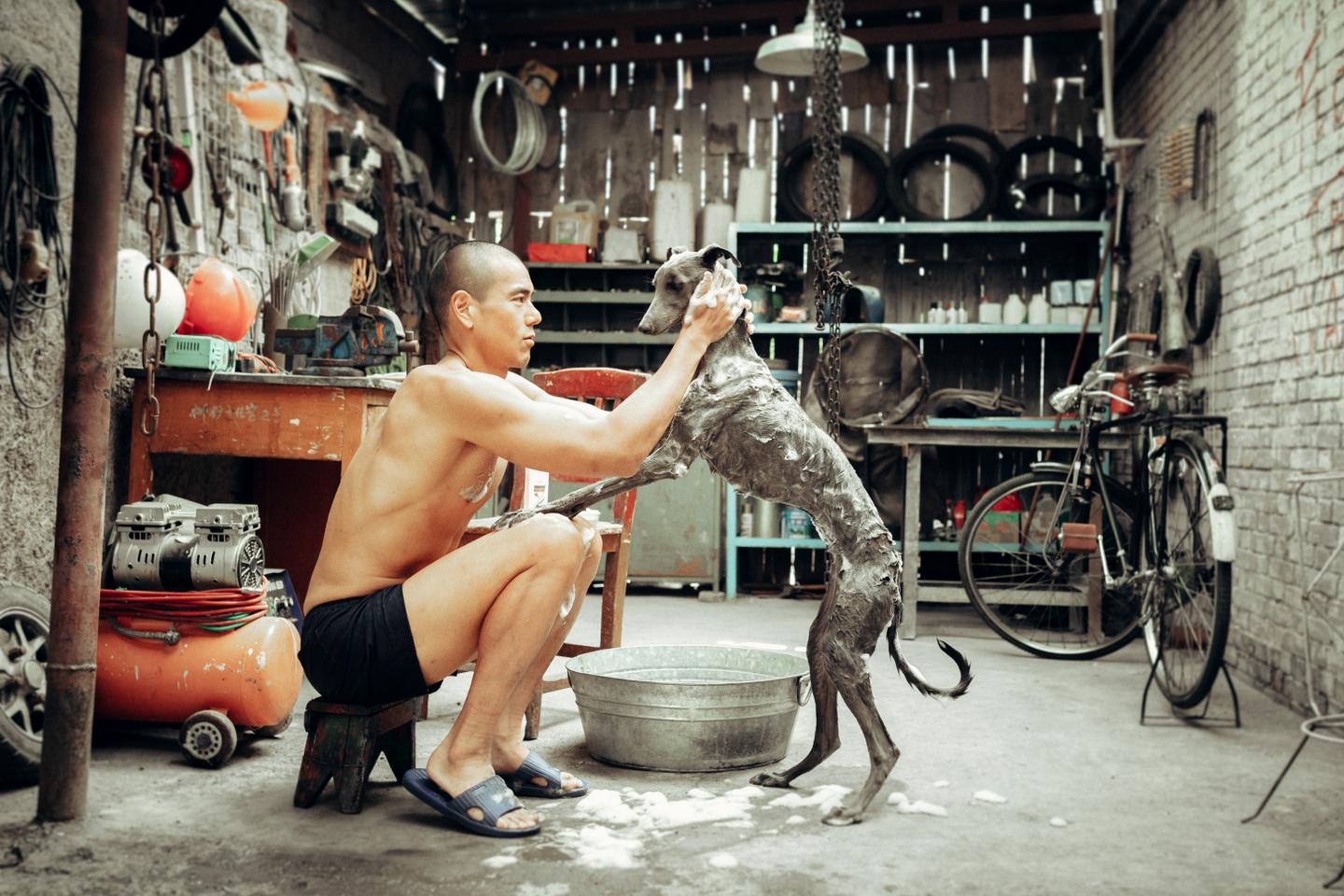
That does not mean that changes aren’t afoot, with the local authorities planning to demolish older parts of town (where Lang’s house is) to make way for new factories. The problem is the town’s population of stray dogs, many of whom roam freely. A particular black dog (Xin) is deemed as the prize catch of them all.
To solve this, local businessman Uncle Yao (Chinese auteur Jia Zhangke) organises teams of local men to round them all up. This is how Lang is assigned to catch these dogs, giving Guan Hu an opportunity to highlight his humanity; in one scene, he secretly returns a young girl’s pet dog, which was unfairly taken away to begin with.
Coming back to the black dog, Lang actually comes across it in an earlier scene in the film. As he was relieving himself at the side of a wall, the dog crawls out from its hiding place, believing Lang to be marking territory he regards as his own. Chasing Lang away, he would proceed to re-mark that territory, an exchange which adds a touch of humour to the proceedings.
The tension between them would later give way to an unlikely friendship. This is due to the both being mirror images of the other. Though Lang was someone well known in the past, that fame has faded, giving way to a pariah status with conditional freedom. “Now you’re on the outside,” says his friend Nie Shili (Zhou You), “you have to play by their rules.”
This applies to the dog as well. Suspected of being rabid, its capture is framed not just as a social and health issue, but also as an economic one; Xin is key to unlocking the area’s future economic prosperity by bringing in new investment which may well make it more relevant to agenda of modern-day Beijing.
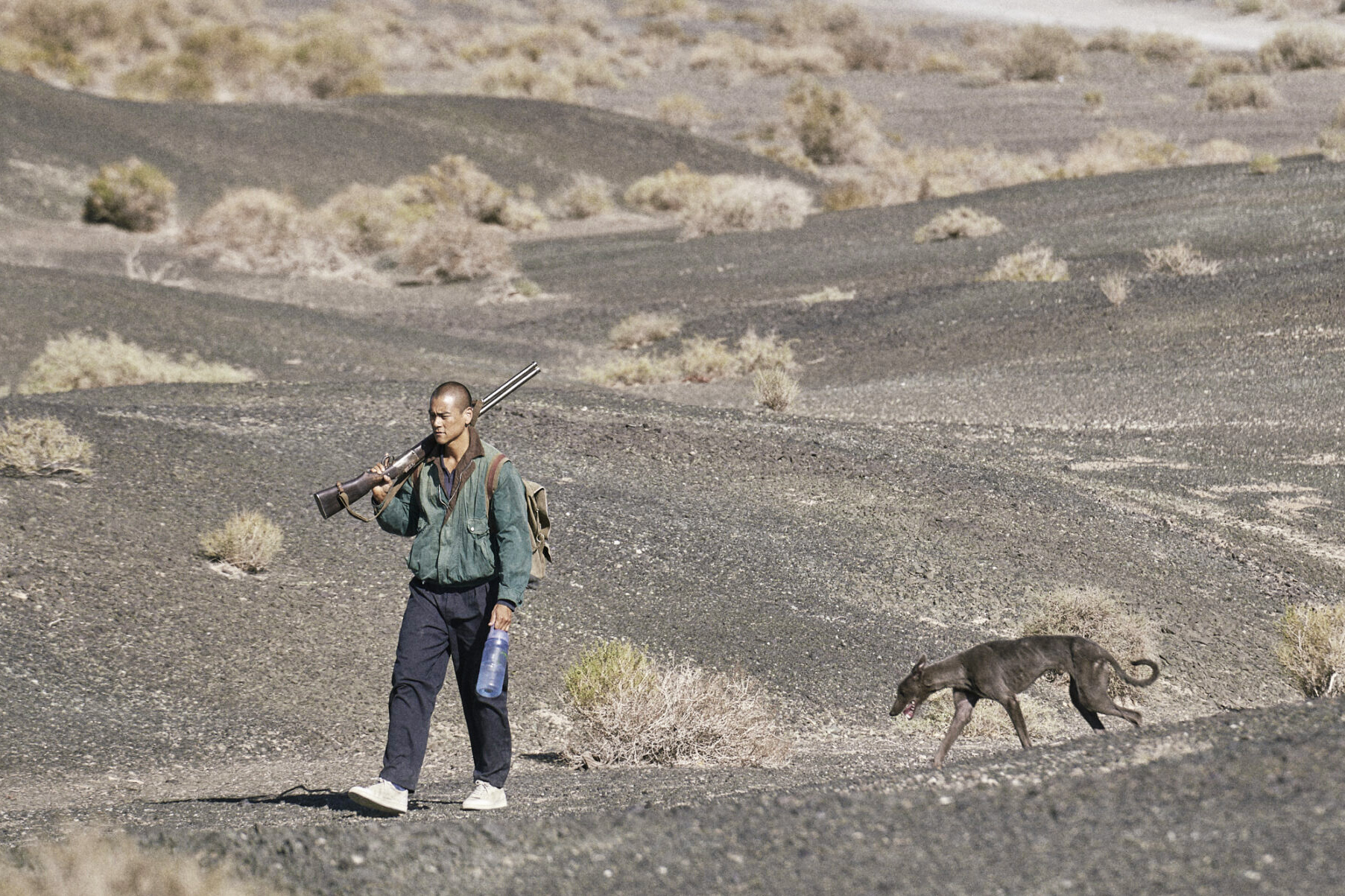
Several shots capture this dichotomy between Lang and Xin. When the dog is captured and loaded unto the truck is also poignant, Lang spends some time studying the now-caged canine, perhaps considering his own predicament. Soon after that, they became stuck in the desert, marking the first time they needed to put their differences aside to survive a sandstorm.
‘Black Dog’ is shot in aesthetically-pleasing perspectives. Though I may have made a meal of the thematic desolation, the vista and its narrative vicissitudes remain beautifully framed by Weizhe Gao, the film’s cinematographer. His ‘every frame a painting’ approach includes plenty of patterns and lines, along with a colour palette both vivid and faded at the same time.
He also has a tendency of letting the camera stay on its sticks, panning only to follow the action from afar and through longer takes. This lack of dynamism actually matches the overall story mood, letting events play out in a more natural fashion; more cuts and close-ups may well raise the pace to less representative levels.
Other filmmaking choices were also interesting, like Lang’s practical muteness in the first half of the film. Several narrative strands could also have been pulled at a little more, such as Lang’s apparent interesting in a travelling circus performer, Grape (Tong Liya), giving us more to look forward to in a place of such bleak prospects.
Then again, ‘Black Dog’ is not just about the satisfactions of one man, given how Chixia and its society are central characters in their own right. In making the film, Guan Hu explores not just the stories less known, but also the spaces we live in; we may well be affected by far-flung layers of capitalism, but even in the middle of nowhere, the sky is a sight for sore eyes.
‘Black Dog’ was nominated in five categories at the 2025 Asian Film Awards, including the category of Best Picture.
Featured image credit: Wolfgang Hasselmann / Unsplash
 thoughtsonfilms.com