

Fikri Jermadi feels that the quality in Awi Suryadi’s latest film does not match the quantity of its elements.
‘Pabrik Gula Uncut’ is the latest entry in the SimpleMan Cinematic Universe that the producer, Manoj Punjabi, is building up. Kicking off with ‘KKN Di Desa Penari’ a few years ago, and with several more entries since then, it is no surprise to see the same team of filmmakers reunite to mine more of SimpleMan’s social media story threads.
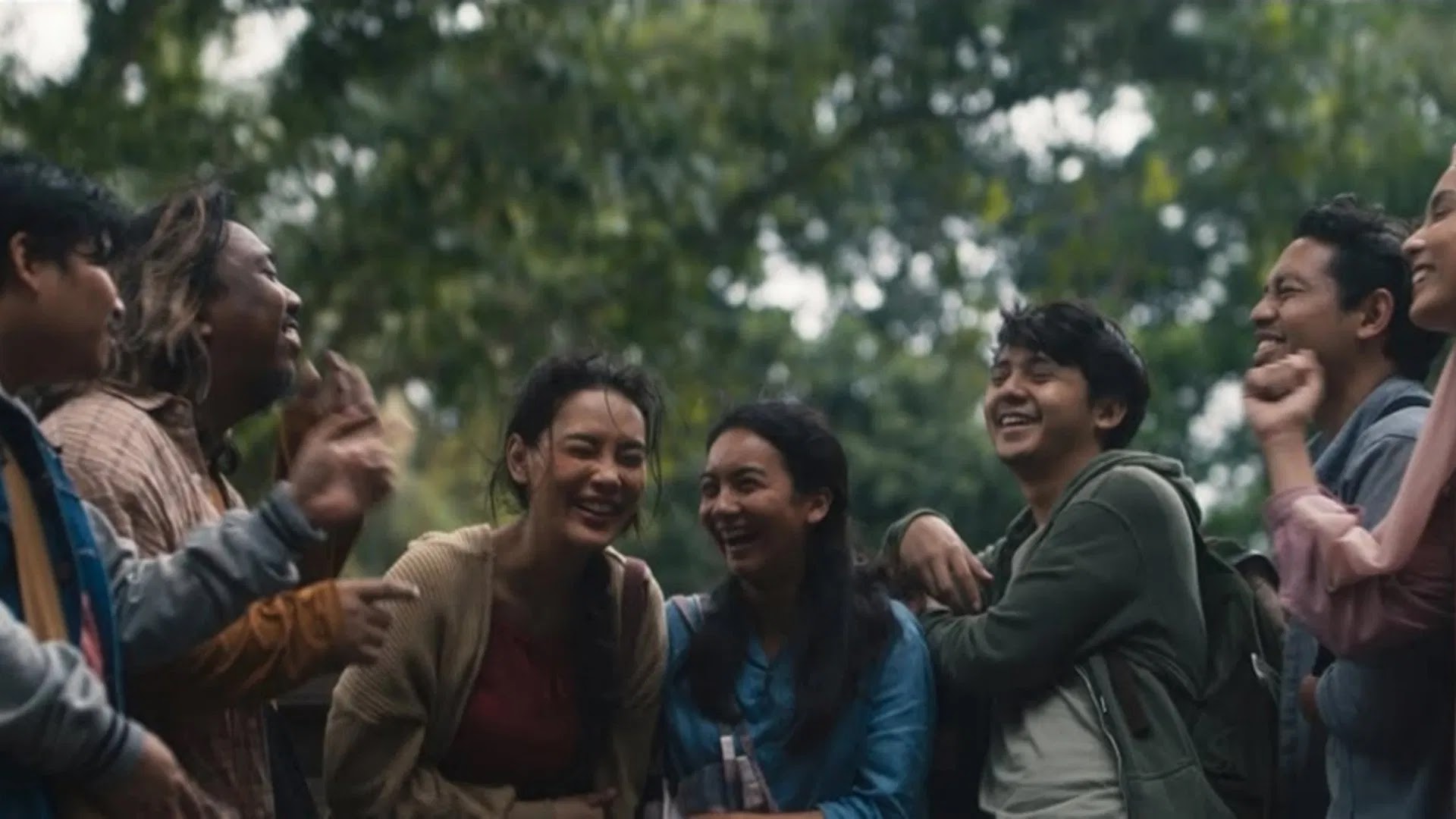
The film tells the story of seven friends: Endah (Ersya Aurelia), Fadhil (Arbani Yasiz), Hendra (Bukie B. Mansyur), Naning (Erika Carlina), Wati (Wavi Zihan), Dwi (Arif Alfiansyah) and Franky (Benidictus Siregar). Friends from a small Javanese village, they depart for seasonal employment at a remote sugar factory, the good pay making up for the tough work.
That is what Hendra and Wati are most interested in, given that they are due to get married soon. The others are along for the ride as much for social reasons as for the economic incentive; in the case of Franky, he is romantically interested in Naning, though it is clear that this is an attraction meant primarily for comic relief more so than anything else.
At the factory, they also meet and become friendly with Rani (Azela Putri). All of them are managed by Bu Marni (Vonny Anggraini), ably supported by her veteran staff members, Samin (Budi Ros) and Jinah (Dewi Pakis). The security team is made up of Rano (Yono Bakrie) and Karno (Sadana Agung), which I will talk about more later on.
The focus now is on the story, led initially by Endah’s curiousity. In exploring the factory alone at night, she broke a cardinal rule she didn’t know about, of workers not being allowed to go out after certain hours. It does, however, set in motion the events which will put human beings on a collision course with the spiritual world.

This is par for the course for films in SimpleMan series, with the prime example being the aforementioned ‘KKN di Desa Penari’. There, we have a group of friends displaced into an unfamiliar context they had to be in, where their actions lead to fateful consequences. That film’s twist and turns also took in a few of the Javanese cultural elements.
The pathway above is identical to the story being told in ‘Pabrik Gula Uncut’. Given that the director (Awi Suryadi) and scriptwriter (Lele Laila) is the same, this should not be a surprise. Yet it is this of such surprises which is a part of the story’s downfall; though many may prefer such well-beaten paths, I had hoped for more in terms of growth and variety.
The first half of the film, in fact, is a repetition of mini narrative cycles of slow build up (aided by the music), with the subsequent (and sudden) soundtrack vacuum being the precursor to the prerequisite jump scare. Of course, it could be argued that this is the norm for films of this ilk, yet my feeling here is that there is greater scope for more variety.
This applies to the interplay of the characters. The majority of the group of friends, for instance, play to type as markers for generic characters across the spectrum, ranging from the pious ones (like Wati) to those who rely on their physique to get ahead (like Naning). Again, while there is nothing particularly wrong with that, this bigger quantity does not translate into greater quality.
This can be clearly seen in the inclusion of not one, not two, not three, but four comic relief characters. This is not a reflection on the actors themselves; in particular, Arif Alfiansyah and Benidictus Siregar have their very funny moments to shine through. All the same, that extra quantity (including Yono Bakrie and Sadana Agung) can feel like an overkill.
For instance, there is a scene in the middle of the film, where we get some key exposition to explain what’s been going on in the story. The rising tension is pricked by a comedic comment by one of the security guards, making too much light of what is a key moment of discovery. This mood killer makes me feel like I shouldn’t take the serious information seriously.
Naming the security guards Rano and Karno is also more distracting than it should have been, being a clear reference to Rano Karno himself (the former actor and current deputy governor of Jakarta). In fact, when Bu Marni calls them earlier in the film, the rapid hailing (“Rano! Karno!”) feels like the invocation of a single person.
Similarly, Franky’s original name being Mulyono feels like a potential dig at Joko Widodo. The former president was originally given this name, but it was changed when he often fell ill as a child. In his final years as the president, however, some of his critics began to use Mulyono as a form of protest against his policies.
As such, I can’t help but think of the above in scenes where Franky refused to be referred to as Mulyono. Perhaps it is more coincidental than it is deliberate, and there appears to be no deeper meaning than just their surface links. All the same, and coming back to the original point, I don’t know which parts and points to take seriously or otherwise.
There is greater clarity and gravity coming from the fine acting of the veteran actors like Budi Ros and Dewi Pakis. In particularly, Dewi’s performance of Jinah is absolutely crucial; while others lose their head easily with their emotions, her character is the compass I use to determine the substance in a sea of uncertain sensationalism.
Perhaps the best way of summing it up is the brief furore over the film posters. The first teaser poster (featuring a female character in a sexually-compromising position) caused much tongue-wagging online. The producers eventually released another poster, and also made two versions available at the same time.
The ‘uncut’ version (which I watched) had an extra minute of running time. I didn’t watch the ‘cut’ version, but I can guess which scene takes up that extra minute. If I am correct, the scene is more salacious than it is significant, and does little to justify the simultaneous release of two different versions.
Then again, it is difficult to argue against its success. ‘KKN Di Desa Penari’ had a similar approach, so this is in line with that bigger picture perspective. ‘Pabrik Gula’ (uncut or otherwise) is also a factor in the post-Ramadhan box office success, with its four million viewers (at the time of writing) contributing to the total of 15 million who watched Indonesian films.
Furthermore, there is a strong interplay of traditional Javanese cultural elements, and I will never not be a fan of that. The inclusion of wayang kulit in a film is never not meta (being accepted as a form of proto-cinema in the region), while the kuda kepang/kuda lumping elements also makes things more interesting than they would have otherwise been.
Ultimately, the film itself is a decent entry into the lexicon of 21st century Indonesian horror. However, by circling the same drain as its predecessors, ‘Pabrik Gula Uncut’ becomes watered down in comparison. Much like sugar in real life, a ‘less is more’ approach could have helped fulfill more of its clear potential, and I hope the filmmakers consider this for future films.
Featured image credit: Heri nugroho / Wikimedia
 thoughtsonfilms.com